Demo project: I generated this app with Bolt as a typical AI-built SaaS, then audited and fixed it exactly as I would for a client.
App: PulseDesk, a customer feedback inbox with a public feedback form, a public roadmap with voting, AI triage and team invites. Built with: Bolt (React, Vite, Tailwind) on Supabase (Postgres, Auth, Storage, Edge Functions). Hosted on: Vercel. Service: security and production-readiness audit, then fixes.
The result
| Before | After | |
|---|---|---|
| Anonymous call to AI function | HTTP 200 — AI-written reply | HTTP 401 — “Sign in to use this feature.” |
npm audit |
High-severity finding | 0 vulnerabilities |
| Failing checklist items | 6 | 0 |
| Pass | 7 | 11 |
| Partial | 1 | 4 |
| Fail | 6 | 0 |
| Open / Unknown | 2 | 1 |
The problem
The app worked in the preview. Features were complete and the database already had Row Level Security. That is the usual state of an AI-built app: the visible 80% works, and the production gaps sit underneath.
I audited it against a 17-point checklist covering security, reliability and deployment.
The audit: what I found (before)
Result: 7 pass, 1 partial, 6 fail, 2 unknown, 1 not applicable.
| Severity | Finding | Why it matters |
|---|---|---|
| High | The AI endpoint accepted the public anon key, so anyone could call it without signing in. | Strangers could spend the owner’s Gemini quota. I confirmed it: an anonymous request returned HTTP 200 with an AI-written reply. |
| High | No rate limiting on the public feedback form, screenshot uploads or roadmap votes. | Spam, storage abuse and vote stuffing were all possible. |
| Medium | CORS was * on all functions. |
Any website could call them from a visitor’s browser. |
| Medium | The Slack notification function trusted a bare feedback id and lost the notification if Slack failed. | Replay abuse and silent data loss. |
| Medium | npm audit reported a high-severity vulnerability in a production dependency. |
Known, fixable. |
| Low | Invite links were built from a client-supplied origin, and the invite email put an unescaped value into HTML. | Phishing and injection risk. |
| Low | Raw error messages were returned to callers. | Information leak. |
| Ops | No CI, no README, no error boundary, no error tracking, no backups. | One bad commit or render error could break the app with no warning. |
Evidence: before
An anonymous call to the AI function succeeds. No login, only the public key (blurred here). The function returns a generated reply.

A high-severity dependency finding.

Row Level Security policies. RLS is on for every table, which is good. The Anyone can submit feedback INSERT policy for anon is what the fix replaced with a rate-limited server path.
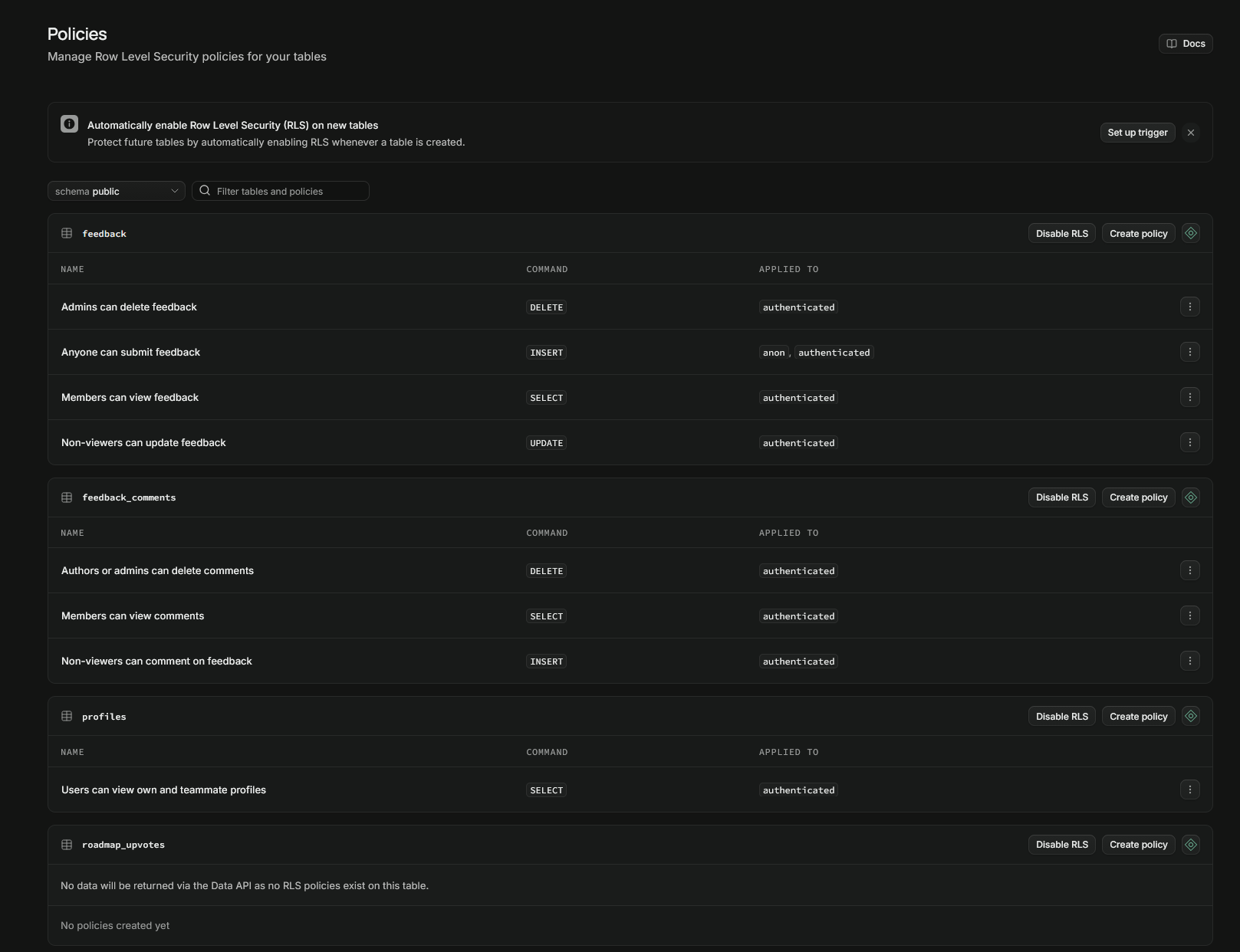
What was already good: RLS on every table, locked-down SECURITY DEFINER functions, no secrets in git, sensible indexes. A good audit says what is right too.
The fixes (after)
- Auth on the AI function.
summarizeanddraft_replynow require a signed-in user. The publicclassifycall is rate limited per IP. - A server-side gate for anonymous writes. Feedback submits, screenshot uploads and votes now go through one edge function that applies database-backed rate limits and, optionally, a captcha. Direct anonymous inserts and uploads were switched off in the database, so the limits cannot be bypassed from the browser.
- Database-level throttles. A trigger rejects floods from one email or into one workspace, and votes are burst limited.
- CORS allow-list driven by an environment variable instead of
*. - Slack function hardening: validates input, only acts on fresh submissions, and releases its claim when Slack fails so it can retry.
- Invite flow: server-side base URL, escaped HTML, generic errors.
- Dependencies: cleared all vulnerabilities, including the dev toolchain (0 reported).
- Operations: GitHub Actions CI (lint, typecheck, build, audit), a React error boundary with optional Sentry, a README with the deploy order, and SPA routing config for hosting. Workflow added and verified locally; not yet run on GitHub.
One bug turned up on the way: signed-in team members could not submit the public form because they had no insert permission. The new path fixed that as well.
Evidence: after
The same call, now blocked.

Dependencies clean.

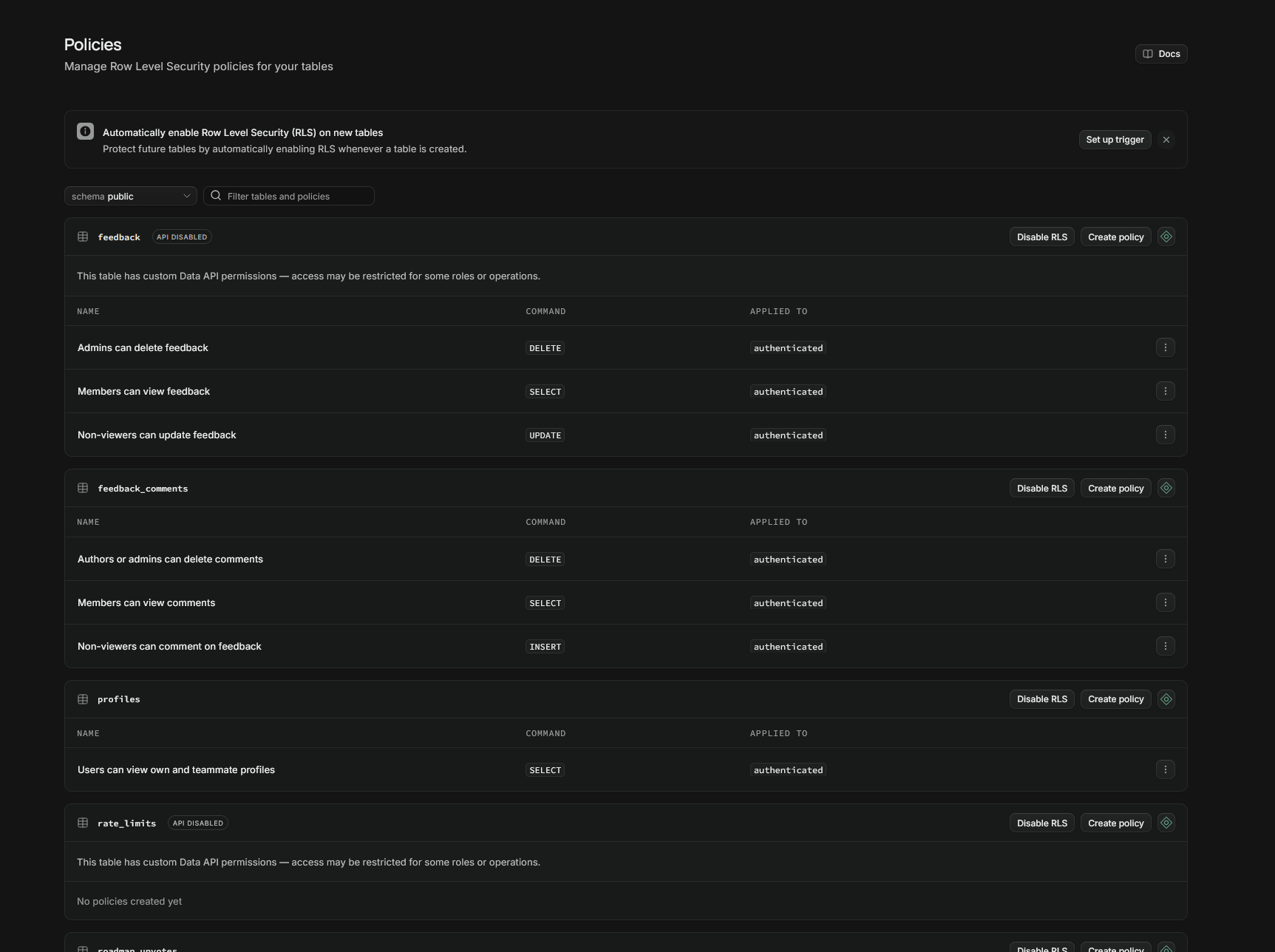
The anonymous INSERT policy is gone. feedback no longer has Anyone can submit feedback. The new rate_limits table has RLS on and no policies, so only the server can touch it.
Still open, and what I’d recommend
- CI: fix the GitHub billing lock (or make the repo public), then re-run the workflow and capture a green run.
- Backups: automated backups need the Supabase Pro plan. I took a manual dump before the migrations and recommended Pro for production.
- Error tracking: create a Sentry project and set
VITE_SENTRY_DSN. The code is already wired in. - Custom domain: connect one in Vercel, then update
APP_URL,ALLOWED_ORIGINSand the Auth URL settings. - Captcha: enable Turnstile (
TURNSTILE_SECRET_KEYandVITE_TURNSTILE_SITE_KEY) for stronger protection on submit and vote.
I would rather list open items than promise “100% secure”. The app was reviewed against this checklist, and each remaining gap is named with a next step.
Takeaways for AI-built apps
- The database layer is often fine. The edge functions and operations are where the gaps are.
- “Requires a JWT” is not “requires a user”. The public anon key is a valid JWT.
- Anything anonymous needs a server-side gate with rate limits.
- Production readiness includes CI, error tracking and backups, not only secure code.
Want this for your app?
I audit apps built with Lovable, Bolt, Cursor and Replit, and can fix what matters. Get in touch with your stack and what the app does.